




ORGANS OF PARIS © 2026 Vincent Hildebrandt HOME ALL ORGANS



Already under the Old Regime, the suburb of
Saint-Antoine was the district of cabinetmakers
and derivative trades (gilders, lackers,
upholsterers, tanners). There were many German
and Alsatian workers whose immigration had
been favoured by the opening of the Strasbourg-
Paris and Muhlouse-Paris railway lines. In 1863,
faced with the increase of Lutherans in the
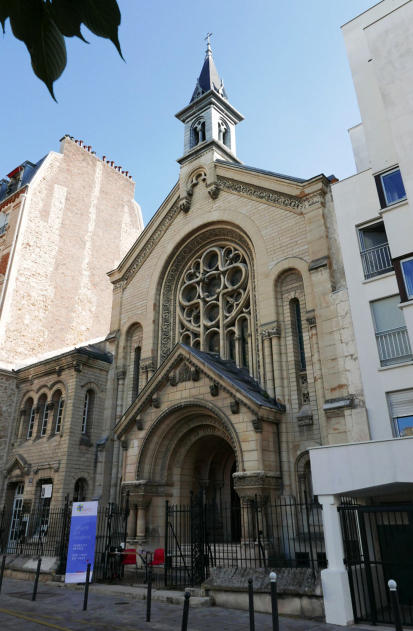
district, a first place of worship was built by
Pastor Hosemann on the site of the former
convent of the Benedictines of Bon-Secours, Rue
de Charonne. The cult then took place alternately
in German and French. A school and an
orphanage are created. In 1893, the complex was
transferred to 4 Titon Street. The first stone of the
temple was laid on June 20, 1895 and the building
was inaugurated on May 10, 1896. Its architect
was the Protestant Adolphe Augustin Rey. It is
built in a neo-Romanesque style, mixing Art-
nouveau elements.
The building has the distinction of being
illuminated by a zenithal canopy, supported by a
beautiful pine frame from North America, witness
to the craftsmanship of the Faubourg Saint-
Antoine.
E6
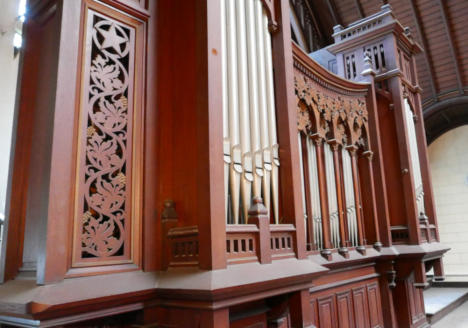
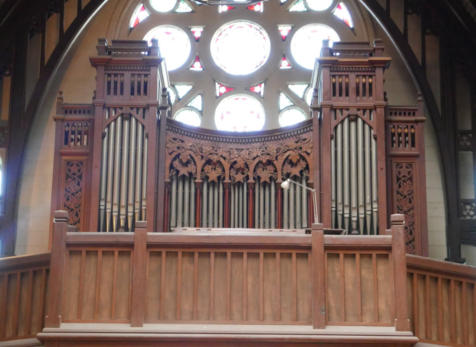
The former instrument was built in 1895 by Merklin. Since
its construction, it has remained totally authentic apart
from a doubling of traction, carried out around 1940 as
well as the addition of a Cymbal III to the GO (perhaps by
Picaud or Sebire?).
In 2020, it was decided to replace the mechanical part with
a second-hand organ. The wooden sideboard has been
preserved.
This second-hand instrument was built by the German
organ builder Wilbrand in 1994. The organ has 15 stops
divided over two 56-note manuals and a 30-note
pedalboard. It is entirely mechanical.
The solid oak windchests are of the slider type and are
fitted with built-in shock absorbers with integrated
regulation.
A main bellows, powered by a motor, supplies wind to the
three windchests via solid oak wind trunks. The frame
supporting the windchests is also made of solid oak.
The console features two manuals with ebony and bone
keys, and a pedalboard made of solid oak.
The pipework (930 pipes) is made of tin and wood. It
includes one reed stop and 14 flue stops. The large
subbass pipes are made of Nordic spruce, the bass pipes
of the 8' stop are in oak, as are the basses of the chimney
flute and Bourdon 8'. The Montre 8' begins at low C in the
façade.
A new frame has been built to support the façade pipes
and encloses the console. It has been stained to blend in
with the dark color of the original case.
Source

1994 - Wilbrand (3)
II/15 - mechanical traction
Stoplist?








Organs of Paris


ORGANS OF PARIS © 2026 Vincent Hildebrandt
E6
The former instrument was built in 1895 by Merklin. Since its
construction, it has remained totally authentic apart from a
doubling of traction, carried out around 1940 as well as the
addition of a Cymbal III to the GO (perhaps by Picaud or
Sebire?).
In 2020, it was decided to replace the mechanical part with a
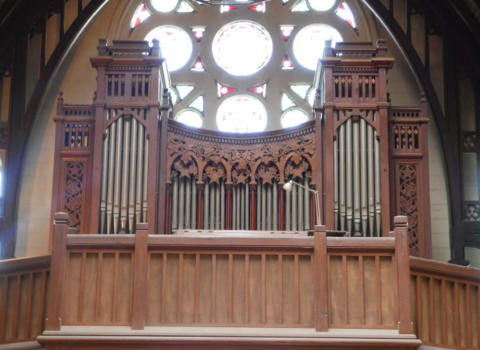
second-hand organ. The wooden sideboard has been
preserved.
This second-hand instrument was built by the German organ
builder Wilbrand in 1994. The organ has 15 stops divided
over two 56-note manuals and a 30-note pedalboard. It is
entirely mechanical.
The solid oak windchests are of the slider type and are fitted
with built-in shock absorbers with integrated regulation.
A main bellows, powered by a motor, supplies wind to the
three windchests via solid oak wind trunks. The frame
supporting the windchests is also made of solid oak.
The console features two manuals with ebony and bone
keys, and a pedalboard made of solid oak.
The pipework (930 pipes) is made of tin and wood. It includes
one reed stop and 14 flue stops. The large subbass pipes are
made of Nordic spruce, the bass pipes of the 8' stop are in
oak, as are the basses of the chimney flute and Bourdon 8'.
The Montre 8' begins at low C in the façade.
A new frame has been built to support the façade pipes and
encloses the console. It has been stained to blend in with the
dark color of the original case.
Source
1994 - Wilbrand (3)
II/15 - mechanical traction
Stoplist?
